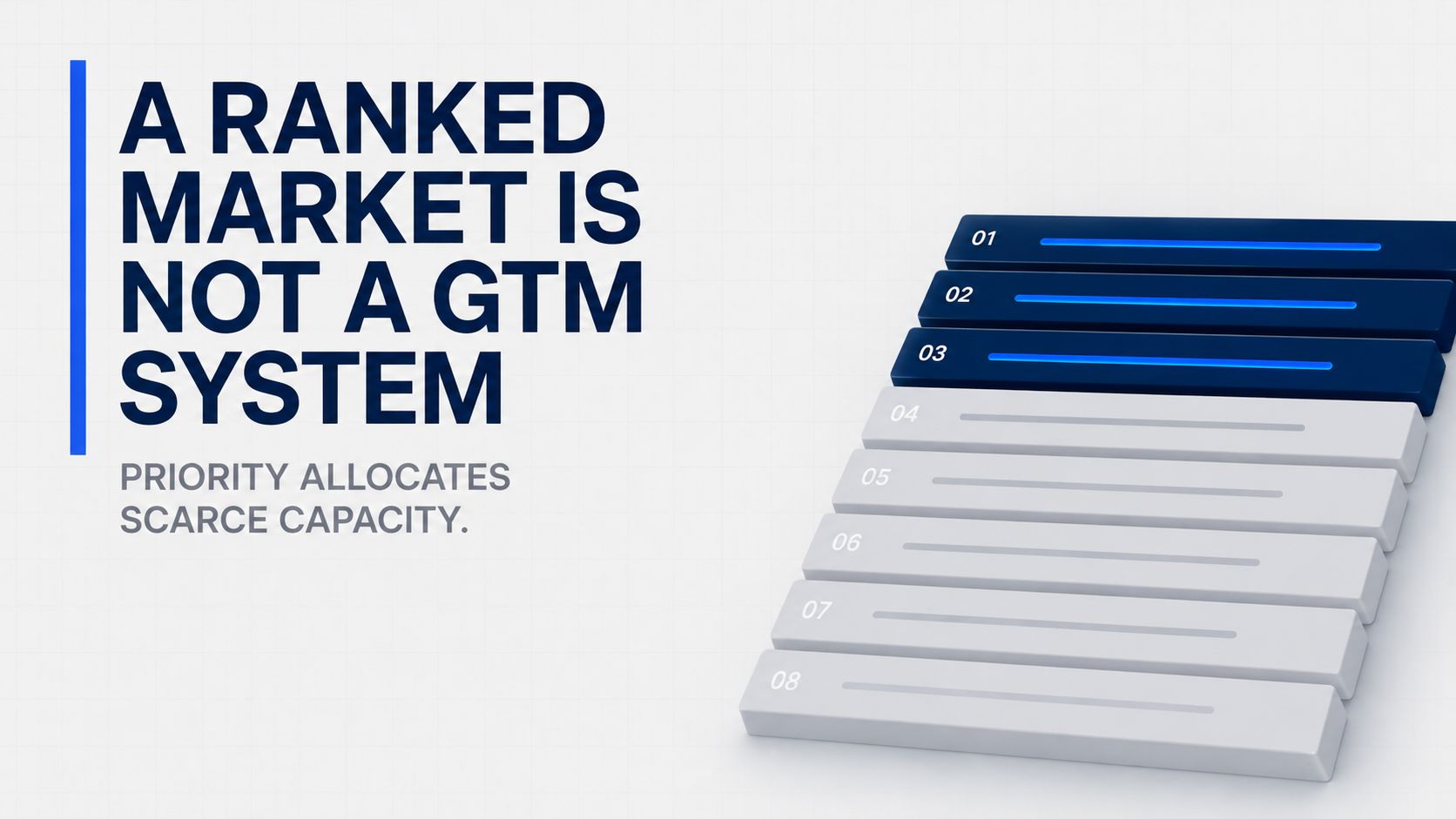
A ranked market is an analytical output.
It is not a go-to-market system.
A ranking can tell a team that one account, segment, or market appears more attractive than another. It cannot decide how much attention the opportunity deserves, who acts next, what evidence moves the work forward, or when the system should change its mind.
Those are operating decisions.
The distinction matters because a model can rank more opportunities than a team can responsibly pursue. Without a finite queue, clear ownership, transition rules, and outcome feedback, the organization has not built a go-to-market system.
It has sorted a list.
Ranking is an analytical output
A ranking compresses evidence into an ordered view.
That can be useful. A company may need to compare markets, accounts, customer types, product opportunities, or partner channels. A consistent model can make the comparison more disciplined than memory, enthusiasm, or whoever spoke most recently.
But the score answers a narrow question.
Given the evidence and assumptions available now, which options appear more attractive relative to the others?
It does not answer:
- How much research is justified?
- Which opportunity deserves attention today?
- Who owns the next action?
- What new evidence would change the position?
- How many opportunities can the team handle at once?
- When should an account leave active pursuit?
- Which outcomes should change the model?
This is the same operating boundary described in a scorecard is a decision system, not a dashboard. Information becomes useful when it connects to an owner, a rule, and a response.
A rank without those connections remains information.
Priority is a claim on scarce capacity
Opportunity and priority are different measures.
Opportunity describes attractiveness. Priority makes a claim on scarce capacity.
That capacity may be seller time, research time, executive access, solution support, marketing effort, travel, partner attention, or delivery expertise. Whatever the constraint is, the organization cannot allocate it to every attractive account at once.
This creates a harder question than scoring:
Why should this work happen before the other work already waiting?
The highest-ranked account may not deserve the next hour. The evidence may be stale. The account may be difficult to reach. A dependency may make action premature. The organization may already have too much work in the same stage. A lower-ranked account may become more actionable because a relevant event changed the timing or a credible path to the buyer appeared.
That does not make the ranking wrong.
It means the ranking is one input into prioritization rather than a substitute for it.
A market and an account answer different questions
A strong account inside a weak market can still be a good opportunity. It may not justify a repeatable market motion.
A strong market can contain many accounts that are poor fits. The concentration may justify investment in local knowledge, partnerships, events, or coverage, but it does not make every institution inside the market equally worth pursuing.
The two levels answer different questions:
- Account suitability: Is this organization a plausible fit for deeper investigation?
- Market practicality: Is there enough concentrated opportunity to justify the fixed cost of a repeatable motion?
Collapsing those questions into one score hides the tradeoff.
A national account strategy may tolerate isolated opportunities because a small number of large wins can justify the effort. A territory strategy may care more about concentration because travel, partnerships, events, and local reputation have fixed costs. A channel strategy may care about whether one relationship creates access to several suitable accounts.
The model should preserve those distinctions. Otherwise, a precise ranking can combine unlike decisions and make the output harder to operate.
A queue needs entrance, transition, and exit rules
A ranked list becomes executable when a finite portion of it enters a governed queue.
The queue needs at least five rules.
Entrance
What evidence is sufficient to move an account from the market universe into active work?
The rule should be stronger than general attractiveness. Active pursuit consumes capacity. The evidence should justify that cost.
Position
What determines where the account sits relative to the other work?
This may include fit, timing, access, evidence quality, strategic value, effort, or the cost of delay. The important point is to state the reasons instead of allowing a seller to translate every interesting signal into urgency.
Ownership
Who is responsible for the next action, and by when?
Shared interest is not ownership. If no one is accountable for producing the next piece of evidence, the account is not in a working queue.
Transition
What evidence moves the account forward, backward, or out?
Seller activity alone is weak evidence. A completed research task or sent message shows that work happened. It may not show that the opportunity improved. The transition should reflect a change in what the team knows or what the buyer has done.
Exit
When does the organization stop spending attention?
Every queue needs a rule for disqualification, delay, reassignment, or return to observation. Without one, old interest accumulates and the active list stops representing active work.
A watchlist protects the pipeline from wishful thinking
Some accounts are attractive but not actionable.
They may fit the market thesis while lacking current evidence of timing, access, need, or a credible next step. Putting them in the pipeline overstates demand. Removing them from the system discards useful context.
A watchlist creates a third state.
The account remains visible, but it does not consume the same attention as active work. It can return to the queue when defined evidence changes.
That evidence may be a public event, a buyer action, a relationship change, a new operating fact, or the expiration of a known constraint. The trigger should be explicit enough that the team can tell the difference between a changed situation and renewed enthusiasm.
This protects the pipeline from becoming a storage place for attractive possibilities. As pipeline problems often start before the pipeline argues, the pipeline is a record of a larger go-to-market system. It becomes unreliable when the decisions that govern entry and movement are unclear.
Outcomes have to change the ranking
A prioritization system should learn from what happens after the queue is built.
Useful feedback includes:
- Which accounts accepted deeper engagement
- Which opportunities ended in no decision
- Which assumptions were disproved during research
- Which account types required disproportionate effort
- Which access paths produced real buyer movement
- Which wins became successful customers
- Which deals created early delivery problems
The last two matter because a go-to-market model can optimize for the wrong outcome. A profile that creates meetings but rarely produces viable work should not remain attractive merely because activity is easy to generate. A profile that closes but creates repeated scope, margin, or onboarding problems should change qualification upstream.
This is why the sales-to-delivery handoff is part of the product. The outcome is not only whether the customer signed. It is whether the organization could keep the promise.
Feedback should not become an excuse to rebuild the model after every result. One loss may be noise. A repeated pattern is evidence. The review rhythm should be stable enough to distinguish between them.
What this does not mean
A prioritization system does not remove judgment from go-to-market work. Evidence will remain incomplete, timing will change, and experienced people will see context the model does not contain. The system should make those judgments visible and testable, not pretend they disappeared.
The prioritization-system test
Use these questions to determine whether a ranking has become an operating system:
- What evidence allows an account or market into active work?
- What determines its position relative to other work?
- Which scarce capacity is being allocated?
- Who owns the next action?
- What evidence must that action produce?
- How many items can the team support at the required quality?
- What moves an item forward, backward, to a watchlist, or out?
- Which outcomes are returned to the model?
- Who reviews whether the assumptions still hold?
- What changed in the last review because the evidence disagreed with the ranking?
If the final answer is nothing, the model may be reporting confidence rather than producing learning.
The ranking should change Monday morning
Market intelligence becomes valuable when it changes how the organization spends attention.
The useful system connects a market universe to evidence, a finite queue, an owner, a next action, an outcome, and a feedback loop.
The ranking is part of that system.
It is not the system itself.
The practical test is simple: Can a specific person use the output to know what to do next, why that work comes first, and what evidence will change the decision?
If not, the team has learned how to order opportunity.
It has not yet learned how to operate it.
Sources and notes
- This article draws on firsthand work designing a financial-services market-intelligence and prioritization workflow. The published argument is limited to general operating principles and excludes proprietary details.