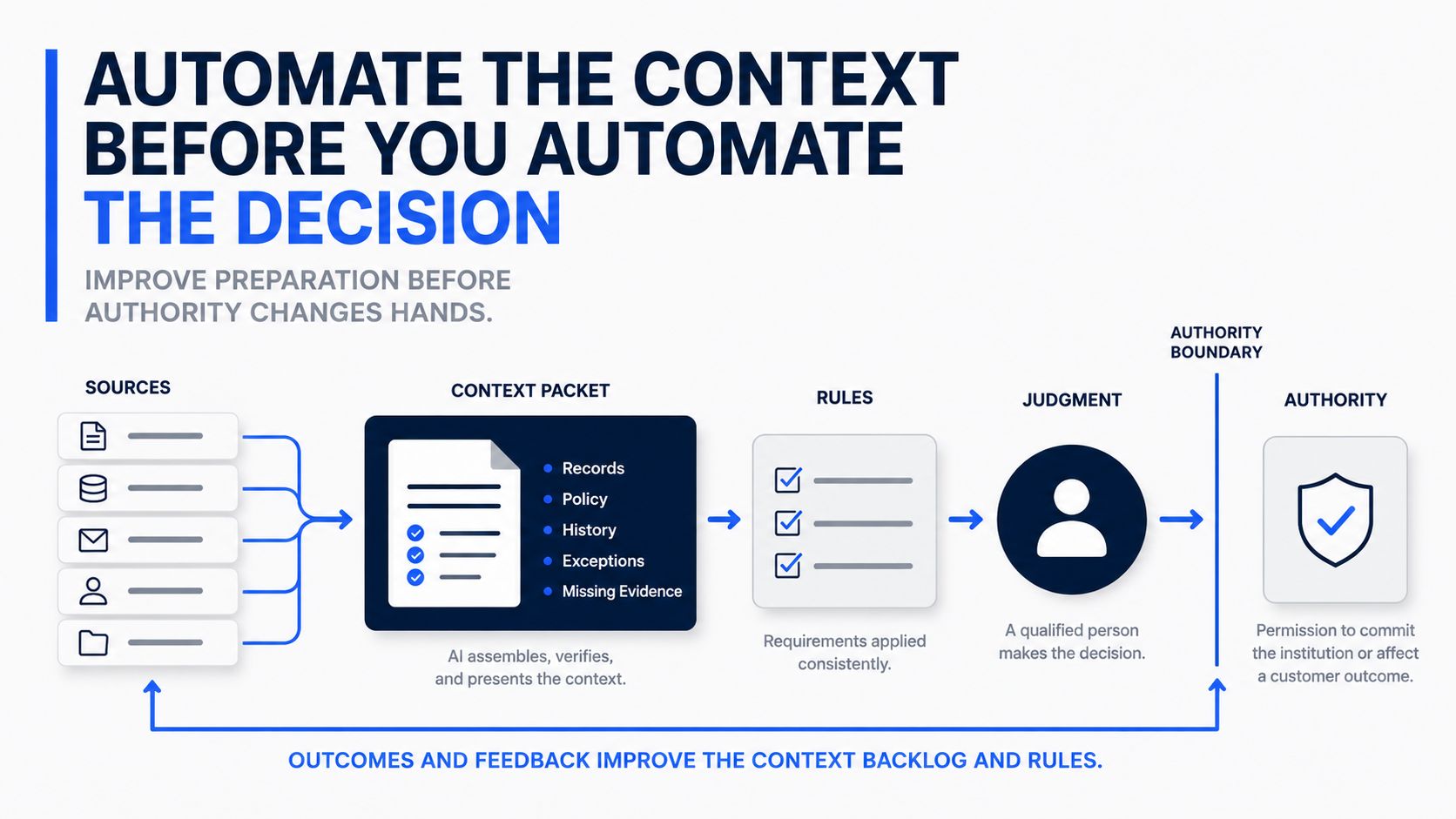
The consequential decision may be the smallest visible part of a much larger workflow.
Consider commercial lending. Before an experienced person can exercise credit judgment, someone may need to find the relevant documents, extract financial information, identify what is missing, retrieve policy, reconcile inconsistent facts, understand the relationship history, surface exceptions, and prepare a defensible case.
Then someone decides.
Organizations often begin the AI conversation with the final moment: Can the system approve the loan?
That skips substantial work that can be improved before judgment or authority changes hands.
The decision is often the smallest part of the workflow
Decisions attract attention because they are visible and consequential.
The work surrounding them is easier to treat as administrative preparation. In practice, that preparation may consume much of the cycle time and qualified attention.
A useful decision package does not appear by itself. People move among documents, systems, policies, messages, prior cases, and customer records. They compare dates and definitions. They search for missing information. They decide which source is authoritative. They translate the result into a form another person can review.
The final decision may be short because the difficult context work already happened.
This creates a better starting question for banking AI:
How much of the information work can be retrieved, verified, reconciled, and presented before the institution changes who decides?
That question does not avoid governance. It makes governance more specific.
Context assembly consumes qualified attention
The people preparing a case often need enough domain knowledge to recognize what is missing or inconsistent.
They may not hold final authority, but the quality of their work shapes the decision. A missing document, stale policy, mismatched customer record, unexplained exception, or compressed summary can change what the decision-maker sees.
AI can help with several parts of this work:
- Retrieve records from approved sources
- Classify and organize documents
- Extract fields with source references
- Compare information across systems
- Identify missing or inconsistent facts
- Retrieve the relevant policy or procedure
- Surface prior related cases
- Prepare a structured summary
- Route exceptions to the right person
- Preserve a record of the evidence used
The Office of the Comptroller of the Currency has identified document reading and information extraction, parts of credit underwriting such as financial analysis and collateral evaluation, fraud detection, and data analysis among current banking AI use cases. It also warns that AI can introduce model, cybersecurity, compliance, privacy, and third-party risks.
The opportunity and the risk sit in the same workflow.
Automating context badly can accelerate the wrong case. The system needs to make the source visible, preserve uncertainty, and allow a qualified person to inspect the underlying evidence.
Separate context, rules, judgment, and authority
One useful way to design the workflow is to separate four layers.
Context
What information does the decision-maker need, where does it come from, and how current is it?
Context work includes retrieval, extraction, reconciliation, history, provenance, and missing-information detection. AI may help assemble the package, but the design should distinguish retrieved fact from generated interpretation.
Rules
Which requirements can be stated consistently?
Some checks are deterministic. A required field is present or it is not. A policy defines a limit. A document is current or expired. AI may retrieve or explain the rule, but a deterministic requirement should not become probabilistic merely because a language model is available.
Judgment
Where do incomplete information, competing objectives, unusual circumstances, credibility, or experience matter?
Judgment is not whatever remains after automation. It should be named deliberately. The organization needs to know which exceptions require domain expertise and what evidence the reviewer must receive.
Authority
Who is allowed to commit the institution or affect the customer?
Authority may include approving credit, closing a case, changing a record, communicating a resolution, moving money, or accepting an exception. Risk rises when an output moves from assistance to action.
This extends the argument in AI governance starts with the decision, not the model. The same underlying capability can create different operating risk depending on the authority granted to it.
Banking has high-value work before the decision
The framework becomes useful when applied to a real workflow.
Commercial lending
AI can help organize borrower documents, extract financial information, identify missing material, retrieve applicable policy, surface relationship history, compare the case with stated requirements, and prepare a review package.
The system can reduce preparation work without making the credit decision.
Fraud and financial-crime operations
AI can consolidate transaction history, account context, related activity, prior cases, and supporting records. It can help an investigator see the case without opening several systems and rebuilding the sequence manually.
The investigator still needs to evaluate what happened, which evidence matters, and what action is authorized.
Complaints and servicing
AI can assemble interaction history, relevant transactions, applicable terms, previous correspondence, prior actions, and available paths. A qualified employee can begin with a coherent record instead of asking the customer to repeat information the institution already has.
The customer may never interact with the AI.
They experience a faster, better-informed employee.
These examples share the same mechanism. The system reduces the cost of finding and organizing context while preserving a distinct decision point.
Better context can improve judgment without replacing it
Preserving human authority is not enough if the reviewer receives a weak package.
A person who sees only an AI summary cannot make an independent judgment. A person who cannot inspect the source, correct the record, reject the output, or escalate the case is present in the interface but constrained in practice.
The National Institute of Standards and Technology AI Risk Management Framework recommends defining the task, use context, knowledge limits, human oversight, roles, and risk tolerance. It also treats documentation as support for human review and accountability.
Those principles translate into practical requirements:
- Every material claim should point to its source.
- Missing information should remain visible.
- Inconsistencies should not be silently reconciled.
- Generated summaries should be tested against the original record.
- Reviewers should be able to revise, reject, and escalate.
- Corrections should become monitoring evidence.
- The system owner should see recurring errors and exceptions.
As human in the loop is two designs, not one explains, the reviewer protects the case while the owner protects the system. Context automation needs both loops.
More autonomy should require more evidence
This argument is about sequence, not a permanent limit on automation.
Some decisions are bounded, low consequence, reversible, and measurable. They may be appropriate for automated action. Others affect credit, money, legal obligations, regulated records, or access to essential services. Those uses require a different standard of evidence and control.
The Consumer Financial Protection Bureau has stated that creditors using complex algorithms still need to provide specific and accurate reasons for adverse actions. Technical complexity does not remove the institution’s obligation to understand and explain the decision.
More broadly, Federal Reserve officials in 2026 have emphasized business-led use, clear guardrails, information security, validation, human accountability, and controls tailored to the risk of the application. That supports a progression rather than a binary choice between no AI and full autonomy.
A reasonable sequence is:
- Assemble context from approved sources.
- Validate extraction, retrieval, and reconciliation.
- Keep deterministic rules explicit.
- Give qualified reviewers source evidence and correction authority.
- Monitor errors, overrides, exceptions, and outcomes.
- Expand authority only when the evidence supports it.
This does not guarantee safety. It makes the next grant of authority inspectable.
It also respects the lesson in every automation inherits the process it enters. If the sources are unreliable, the rules conflict, or ownership is unclear, AI will inherit those defects.
The context-automation test
Before automating a consequential decision, ask:
- What information does the qualified person assemble manually today?
- Which sources are authoritative?
- Which information can be retrieved rather than inferred?
- Which checks are deterministic?
- Where does interpretation begin?
- Which exceptions require domain judgment?
- What authority does the final decision carry?
- What evidence must remain after the decision?
- Can AI reduce preparation time without changing who decides?
- What new evidence would justify more authority later?
The ninth question often reveals the first useful production use case.
The tenth prevents the organization from treating autonomy as an aspiration rather than a decision that needs proof.
The first useful AI may be invisible
Regional banks and credit unions do not need to begin by replicating the AI infrastructure or customer interfaces of the largest institutions.
They can begin inside one consequential workflow.
Find the work required to assemble reliable context. Separate it from deterministic rules, domain judgment, and final authority. Improve the preparation. Measure the result. Preserve the evidence and the right to disagree.
The customer may never see the system.
They may only experience a lender who arrives prepared, an investigator who sees the complete case, or a service employee who understands the history without asking the customer to reconstruct it.
You do not have to automate the consequential decision to improve the economics of making it.
Sources and notes
- Office of the Comptroller of the Currency, Semiannual Risk Perspective, Spring 2025, on current banking AI use cases and the related model, cybersecurity, compliance, privacy, and third-party risks.
- Federal Reserve Governor Christopher Waller, Operationalizing AI at the Federal Reserve, on business-led adoption, information-security controls, validation, human accountability, and ongoing evaluation.
- Federal Reserve Vice Chair for Supervision Michelle Bowman, Responsible innovation and financial inclusion, on proportionate oversight and controls tailored to each AI application, including the constraints smaller banks face.
- National Institute of Standards and Technology, AI Risk Management Framework Core, on defining use context, knowledge limits, human oversight, roles, documentation, and risk tolerance.
- Consumer Financial Protection Bureau Circular 2022-03, on the requirement to provide specific and accurate reasons for adverse actions even when complex algorithms support credit decisions.
- This article provides an operating framework, not legal or regulatory advice. Requirements depend on the institution, jurisdiction, data, use case, authority granted to the system, and consequence of error.