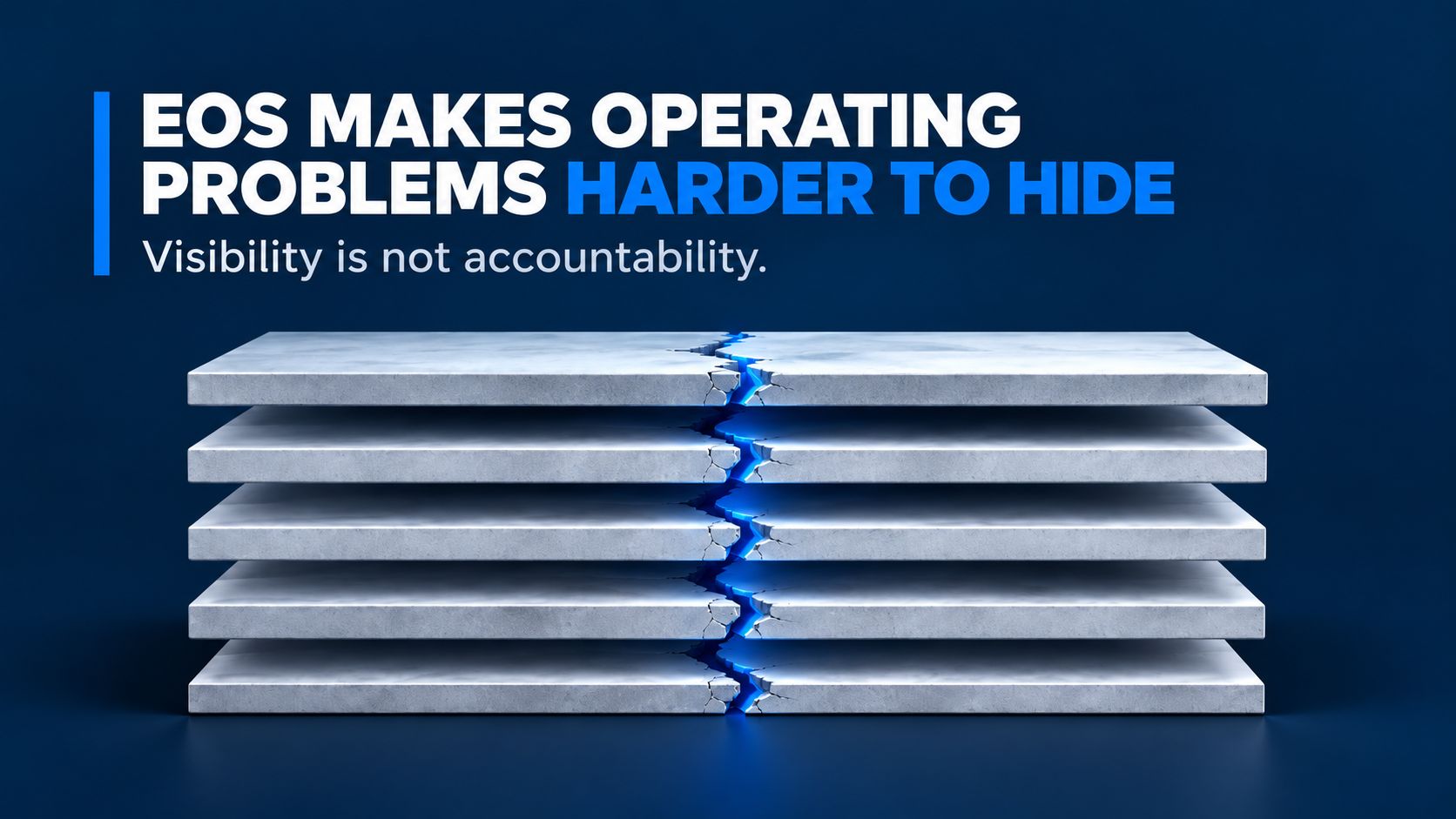
EOS does not solve operating problems.
It makes them harder to hide.
I have implemented EOS at six organizations and served in integrator roles. The most useful lesson was not that a framework solves the company. It was that a functioning operating system keeps placing the same reality in front of the leadership team until the pattern becomes difficult to explain away.
Quarterly priorities, scorecards, ownership, issues, meetings, and documented process create recurring evidence.
The leadership team still has to act on what the evidence reveals.
EOS is useful because it creates recurring evidence
This is not an explanation of the Entrepreneurial Operating System or an endorsement of every part of it.
EOS is useful here because its mechanics make a broader operating principle easy to see. The framework connects vision, people, data, issues, process, and execution through a set of recurring tools and rhythms.
The tools give problems a place to appear:
- The Vision/Traction Organizer (V/TO) places long-range direction, the annual plan, quarterly priorities, core values, and focus on one shared surface.
- Quarterly priorities show what the company says matters now.
- A scorecard shows whether important activity and outcomes are on track.
- An accountability chart shows who owns the roles required to run the business.
- An issues list gives unresolved problems a visible queue.
- A weekly meeting creates a recurring review of numbers, priorities, commitments, and issues.
- Documented processes show how repeatable work is supposed to happen.
None of those artifacts guarantees a good decision.
Together, they reduce the number of places where operating contradictions can hide.
The V/TO reveals a common growth constraint. Strategy can be coherent inside one leader’s head and still be unusable by everyone else. Moving the direction, priorities, and operating assumptions onto a shared surface makes them legible enough for other people to challenge, own, and execute.
Growth does not create that communication gap. It raises the cost of leaving the strategy private.
Priorities expose capacity
A priority is not only a statement of importance.
It is a claim on capacity.
Once a leadership team chooses a short list of quarterly priorities, it becomes harder to pretend that every initiative deserves the same people, time, money, and executive attention. The team has to decide what work receives protection and what work waits.
The contradiction appears when the priority list changes but resource allocation does not.
A leader owns an important initiative but remains consumed by daily work. A cross-functional priority has no shared capacity. A new project enters the quarter without another commitment leaving. Everything remains urgent, so nothing receives the focus implied by the plan.
The operating system did not create the capacity problem.
It made the gap between stated priority and actual allocation visible.
That is useful evidence. The leadership decision may be to add capacity, reduce scope, change ownership, stop other work, or admit that the priority is not real.
Keeping every priority while changing none of those conditions is also a decision. The system simply makes that decision easier to see.
Numbers and ownership turn ambiguity into evidence
A scorecard converts general confidence into something the team can inspect.
That does not mean the number is automatically correct. The definition may be weak. The source may be unreliable. The target may reward the wrong behavior. The measure may arrive too late to change the outcome.
But a recurring number gives disagreement a specific location.
The team can challenge the definition, owner, target, trend, or response. It can ask why a measure is off track and whether the variance requires a decision. It can see when the same explanation appears week after week.
As a scorecard is a decision system, not a dashboard argues, the useful unit is not the chart. It is the connection among a measure, an owner, a threshold, and a response.
Ownership creates a similar form of visibility.
A reorganization often begins with names. An accountability chart reverses the sequence: define the functions and seats the business requires, state the few roles each seat owns, and then assign people.
That order tests the structure before testing individual fit. It makes missing functions, duplicated ownership, overloaded seats, and responsibility without authority visible before the existing team shape settles the answer.
When a result belongs to one role, the team can inspect whether that role has the authority, capacity, information, and support required to produce it. If several people believe they own the decision, the overlap becomes visible. If nobody owns it, the gap becomes visible. If one person carries accountability while another person retains authority, the structural conflict becomes visible.
An accountability chart cannot repair that conflict.
It can stop the conflict from hiding inside the phrase the team owns it.
Issues and meeting cadence reveal avoidance patterns
An issue list is valuable because it gives unresolved reality a durable place to live.
Problems otherwise disappear into hallway conversations, private frustration, email, or the hope that conditions will improve. A shared list preserves the fact that the issue exists even when the team is not ready to solve it.
The recurring meeting adds time to that visibility.
One missed commitment may be an exception. A commitment that moves every week is a pattern.
One issue may require more investigation. The same issue returning after several discussions may indicate that the team has not identified the root cause, lacks authority to resolve it, or is avoiding the decision the issue actually requires.
This is why a leadership meeting should produce decisions, not updates. The meeting is not valuable because it gathers the leadership team. It is valuable when recurring evidence becomes a decision and the decision becomes a commitment that can be reviewed later.
Cadence creates memory.
The organization can no longer treat every missed date, repeated issue, or deferred decision as though it happened for the first time.
Process shows where repeatability is fiction
Documented process creates a visible standard for how recurring work is supposed to happen.
The standard may be incomplete or wrong. That is still useful. The team can compare the documented path with the work people actually perform.
The gaps reveal operating information:
- Employees use a workaround because the formal system cannot handle a common case.
- A handoff depends on information the prior step does not capture.
- The documented approval path conflicts with the authority people use in practice.
- One experienced person remembers exceptions that the process does not contain.
- A recurring rescue is treated as individual excellence instead of a system defect.
If the work succeeds only when one person intervenes, the process is not repeatable. The documentation may say otherwise, but the difference between the document and the work makes the dependency visible.
That connects to the founder bottleneck is an operating-system problem. Hero dependence is rarely solved by asking the hero to work harder. It is reduced by moving decisions, information, and recurring work into a system other people can run.
Visibility is not accountability
A company can implement the mechanics correctly and still avoid the underlying problem.
The team can redefine a priority until it appears complete.
It can choose numbers that avoid the real risk.
It can name an owner who lacks authority.
It can discuss an issue without making the difficult personnel, resource, customer, or strategy decision.
It can move a commitment with a convincing explanation.
It can document the ideal process while continuing to reward rescue.
The artifacts remain.
The operating reality is still being rationalized.
This is the boundary described in accountability without candor becomes theater. A team can have goals, owners, scorecards, and meetings while reporting a cleaner version of reality than the business is living.
EOS itself recognizes the dependence on openness, honesty, and a willingness to face reality. The framework can create the conditions for a candid conversation. It cannot make the leadership team have one.
What this does not mean
A recurring issue does not always prove avoidance, and an off-track priority does not automatically prove weak leadership. Conditions change. Evidence arrives late. Capacity can be disrupted. Some problems require several decisions. The pattern is a reason to inspect the system, not a verdict about the person.
What has become harder to hide?
Text version
| Operating area | What looks orderly | Contradiction exposed | What it reveals |
|---|---|---|---|
| Priorities | Quarterly priorities are named. | Too much work still remains top priority. | Capacity does not match the list. |
| Numbers | The scorecard is reviewed every week. | The same measure stays outside the range. | The team is not aligned on what is happening. |
| Ownership | Roles and owners are clearly assigned. | Responsibility exists without real authority. | Decisions stall and handoffs create delay. |
| Issues | Issues are surfaced and discussed. | The same issue keeps coming back. | Root causes are not being solved. |
| Commitments | Weekly commitments are reviewed. | Dates keep moving forward. | Work is not finishing as promised. |
| Process | The core process is documented. | Critical work still depends on memory. | The system still relies on heroics. |
Use this diagnostic after the operating rhythm has had enough time to produce patterns:
- Which priorities lack the capacity required to finish?
- Which numbers keep moving the wrong way despite repeated explanation?
- Which decisions return because authority is unclear?
- Which roles carry responsibility without the right information or decision rights?
- Which issues have survived several meetings without a materially different action?
- Which commitments routinely move instead of finishing?
- Which processes still depend on one person’s memory or intervention?
- Which exceptions have become normal work?
- Which status labels protect appearance instead of describing evidence?
- What contradiction is now visible that the leadership team still refuses to name?
The final question matters most.
An operating system earns its value when it improves the fidelity of the information reaching the decision.
The operating system should increase the cost of denial
The purpose of an operating system is not to make the organization look organized.
It is to help the organization see, decide, and act with less dependence on memory, politics, and rescue.
EOS can support that work by placing priorities, numbers, ownership, issues, commitments, and process into a recurring structure.
The structure does not solve the problem.
It makes the unresolved problem return with evidence.
That is not accountability by itself.
It is what makes continued avoidance harder to mistake for progress.
Sources and notes
- Gino Wickman, Traction, on the EOS Model, quarterly priorities, the Accountability Chart, Scorecard, Issues List, core processes, meeting pulse, and the requirement for an open, honest, and vulnerable leadership team.
- Gino Wickman and Mike Paton, Get a Grip, on how the Accountability Chart, quarterly priorities, Scorecard, Issues List, recurring meeting, and issue-solving discipline operate together inside a leadership team.
- Gino Wickman and Tom Bouwer, What the Heck Is EOS?, on employee participation in measurables, issues, process, priorities, meetings, accountability, and open communication.
- EOS Worldwide, The EOS Model, for the current official description of the six components and foundational tools.
- EOS Worldwide, What is the EOS Issues List? and What is a Level 10 Meeting?, for the current official descriptions of issue visibility and the recurring leadership-meeting structure.
- I have implemented EOS at six organizations and served in integrator roles. I am not an EOS Implementer, am not certified by EOS Worldwide, and have no affiliation with EOS Worldwide. References to EOS and its tools are editorial and do not imply endorsement, affiliation, certification, or licensed use.