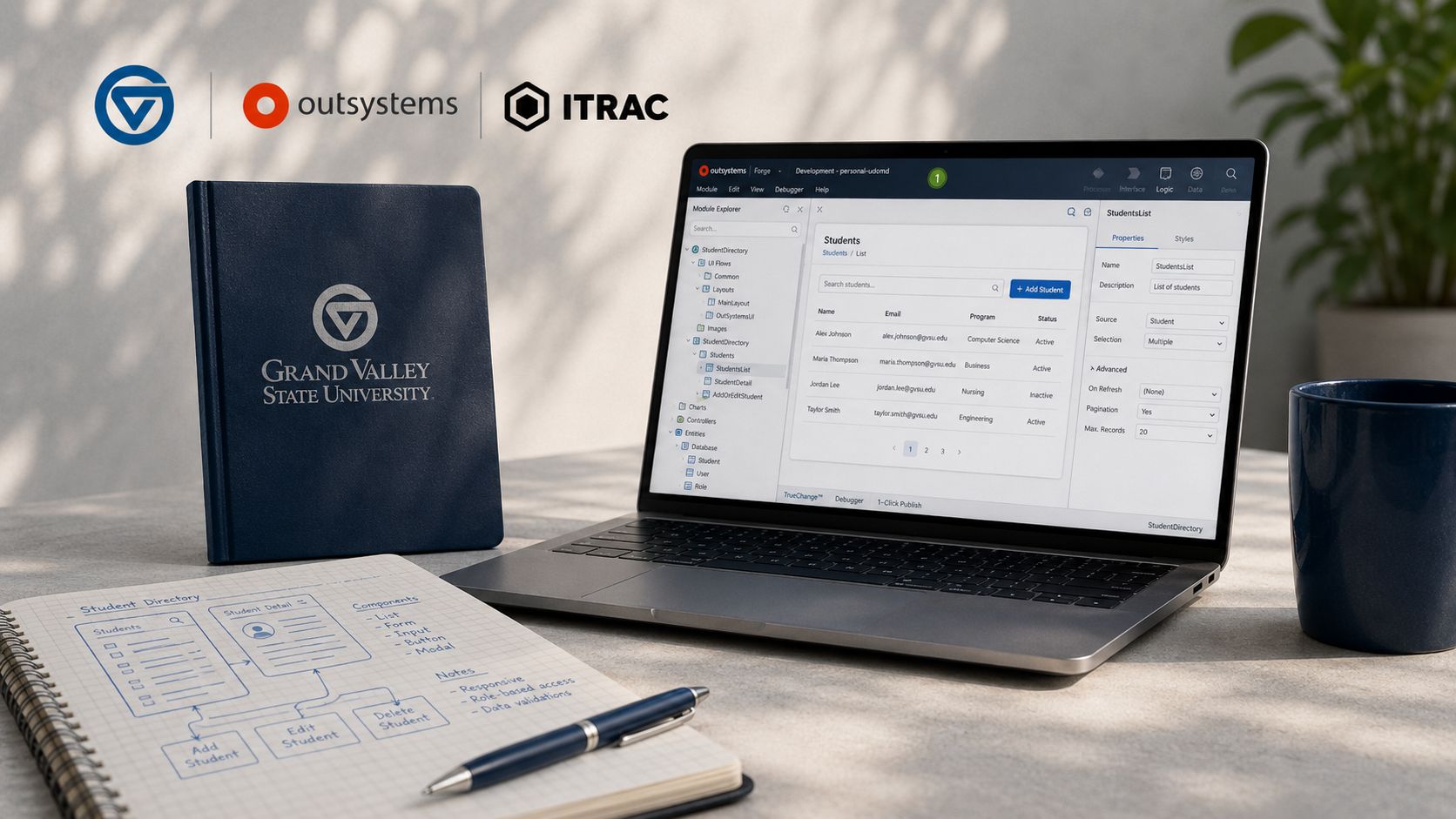
More technical training does not automatically create more employable talent.
A course can teach useful skills. A completion certificate can record that a learner finished. A certification exam can test a defined body of knowledge.
None of those steps, by itself, gives an employer enough evidence to trust someone with production work.
The missing layer is an evidence-carrying handoff between learning and work. Learners need a real project, observed practice, useful feedback, career preparation, and a way for employers to inspect what they can do. Employers need more than a list of graduates. They need a hiring signal connected to the work they actually need performed.
When I helped launch the Grand Valley State University and ITRAC partnership and shape the curriculum, that handoff was part of the design.
A class without a work path ends at completion
A course can be designed entirely around the curriculum.
It can define the lessons, schedule the sessions, create assessments, and issue a completion record.
That can produce a good class.
It does not necessarily produce a talent pipeline.
A pipeline has a destination. It connects developing talent to a defined set of employer needs, and it carries evidence through the system so the next person can make a better decision.
When the program ends at graduation, the school can show attendance and completion. The learner can list a credential. The employer still has to determine whether the person can solve a problem, communicate tradeoffs, accept feedback, and complete work inside an enterprise environment.
That leaves the learner carrying most of the translation burden.
They have to turn a course title into a credible story about capability. They have to explain what they built, what changed under review, what they learned, and what they can be trusted to do next.
A credential may open the conversation.
It rarely completes it.
The GVSU and ITRAC partnership was designed around that gap.
The ten-week program asks learners to build a responsive web application, present recorded demonstrations, receive instructor and peer feedback, prepare for the OutSystems Associate Developer exam, and work through career coaching.
The pieces matter because they create a record of practice, not only a record of attendance.
The category moved, and the evidence question moved with it
For most of the last decade, this platform was described as low-code. The category language did real work. It told a buyer that development happened visually, that a small team could cover more ground, and that delivery was faster than hand-writing every layer.
That is no longer how OutSystems leads.
The company now positions itself as an AI development platform and frames agentic systems as the method rather than a feature. Mentor assists the build. Agent Workbench builds and governs agents. The argument has moved from speed against hand-coding to governed delivery when the code is generated.
Low-code is not wrong. It is history. It describes how the platform got here, not what it is selling now.
That shift changes what a training program has to produce.
When code was expensive, the hiring signal was whether someone could write it. When code is generated, the hiring signal moves up the stack. Can the learner model data correctly in the first place? Can they look at a generated screen and say why it is wrong? Can they recognize when the platform had no business context and is confidently producing rework?
OutSystems product leadership makes a version of this argument about agents specifically: agents are software, which means every failure mode that applies to software applies to them, at greater scale. That is a governance argument, and governance is a judgment problem before it is a tooling problem.
Judgment is exactly what a multiple-choice exam cannot certify.
It is also exactly what a project under review can begin to show.
The program is built for that. It is offered as AI-Powered App Development. Week one includes a demonstration of OutSystems Mentor and AI Agent Builder, the agent tooling that preceded Agent Workbench. One of the stated outcomes is being able to explain how AI and low-code increase delivery speed while preserving control and quality.
That last outcome is the one worth noticing. It is not “use the AI.” It is “explain the tradeoff.” Those are different skills, and only one of them survives contact with an enterprise change board.
Learners need evidence that survives the classroom
The completion certificate matters.
The more useful hiring signal is the body of evidence created while earning it.
The official GVSU program page says learners build and deploy web applications, model data, implement business logic, integrate external services, apply roles and permissions, and work through enterprise deployment practices. The capstone is a working application plus a short presentation that explains the use case, technical choices, and lessons learned.
That gives the learner something concrete to carry forward.
A finished application shows that the learner moved beyond isolated exercises. Recorded demonstrations show whether the learner can explain the work. Feedback checkpoints show that the project changed under review rather than remaining a first draft.
The structure also exposes skills that a multiple-choice exam cannot fully show. Instructors can observe how a learner responds to review. Peers can see whether the learner gives and receives useful feedback. The project gives the learner a concrete artifact to discuss in a portfolio or interview.
These are early signals.
They are not proof of senior judgment.
They are still stronger than a credential standing alone.
Name the exam, because the specifics are the evidence
There is no single OutSystems developer certification, and the difference is the kind of detail a hiring manager can actually use.
The exam this program prepares learners for is Associate Developer (ODC). OutSystems describes it as an assessment of ODC application-development fundamentals, common to web and mobile: data modeling, UI development, logic, screen lifecycle, and modular architecture.
ODC is the current cloud-native generation of the platform. OutSystems 11 is the previous generation, and it still runs a large share of the production estate a new developer will walk into on their first day. The course targets ODC and gives learners exposure to O11 as well, because a candidate who only knows one generation is a candidate with a narrower first job.
That is a precise thing to put on a resume. It is also a precise thing for an employer to ask about. Which generation? Which exam? What did you build in it, and what broke?
The credential also has a defined next rung. OutSystems offers an Agentic AI Specialist (ODC) specialization that requires Associate Developer (ODC) first. So the ten weeks are not a terminal credential. They are the prerequisite for the part of the platform the market is actually hiring toward.
The mistake is asking any single credential to answer a larger question than it was designed to answer.
Who teaches it is part of the evidence
Feedback is only as good as the person giving it.
That is the quiet dependency inside the third layer. A program can promise observed feedback and deliver a rubric. The difference is whether the reviewer has ever carried responsibility for the kind of work the learner is trying to enter.
The course is taught by Edgar Ramos, ITRAC’s Head of Development and Training and an OutSystems Champion.
He has run OutSystems delivery at scale. At NTT DATA he led the OutSystems practice across Europe and LATAM with a team of 125 engineers, and grew a nearshore center in Castelo Branco and Porto from zero to thirty. Before that he ran an OutSystems Center of Excellence and delivered a large-scale project for a US client. His delivery background runs through government, utilities, telecom, and other regulated environments.
He also teaches for a living. He is an assistant professor at Instituto Politécnico de Castelo Branco, teaching interface design, project management, and human-machine interaction, and supervising applied research in AI, UX, and service design. He holds the Specialist Title in Information Systems at EQF Level 8.
And he is a published AI/ML researcher with hands-on work in computer vision and applied machine learning.
That last credential is why the AI framing of this course is not decoration. The person teaching learners how AI-assisted development behaves has built the underlying systems. He can explain what the model is doing, where it is guessing, and why the answer looked confident and was still wrong. Very few people teaching low-code can do that.
He has been organizing OutSystems community meetups since 2020. His user group won the OutSystems Most Organized User Group award in 2022.
So the feedback a learner receives is not generic instructional feedback. It comes from someone who has hired for these roles, staffed them, and had to decide what a new developer could safely be trusted with in week one.
That is the difference between observed feedback and graded work.
The handoff needs an owner
A university can provide structure, academic accountability, and a recognized learning environment.
The work after the class requires another operating layer.
Someone has to understand employer demand, define candidate profiles, observe learner behavior, prepare learners for hiring conversations, and coordinate introductions when the fit is credible.
In this program, ITRAC owns that bridge.
GVSU states that qualified graduates receive career coaching through ITRAC and may be matched to employers. Job placement is not guaranteed.
That boundary matters because the value of the bridge is not a promise of employment.
The value is that someone owns the translation between training evidence and employer need.
Without that ownership, the course and the employer remain separate systems. The learner is expected to bridge them alone.
With it, evidence created in the class can move with the learner into the hiring process.
That is the same operating principle behind treating the sales-to-delivery handoff as part of the product. A handoff works when the information needed by the next system travels with the work.
Employers have to define the entry point
A talent pipeline cannot be built from the education side alone.
Employers have to describe the work a new developer can perform under supervision, the controls that cannot be bypassed, the review capacity available, and the evidence required before more authority is granted.
A generic request for an experienced developer does not help a training partner design an entry path.
A defined role does.
The public GVSU program makes this employer side explicit. ITRAC works with corporate partners to define the profiles they need and coordinate introductions to qualified learners.
The pipeline also runs the other direction. ITRAC delivers corporate training, so an employer with a specific gap does not have to wait for the general cohort to produce it. If the need is ODC migration readiness, or agent governance, or a team that has to move from O11 without stopping delivery, that can be built as its own program against the profile the employer names.
That is the mechanism.
Employer demand shapes the target. The course produces relevant practice. Instructors observe the work. Learners leave with inspectable evidence. Matching can happen against a defined need rather than a broad claim that every graduate is ready for every role.
That also protects the learner.
A vague promise of opportunity can push a new developer into a role with no support and no realistic success condition. A defined entry role makes the boundary visible. The learner can understand what is expected, where review will occur, and what capability must be developed next.
The employer gets a more realistic hiring decision.
The learner gets a role designed for progression rather than immediate independence.
Ten weeks should improve the starting point
A ten-week program does not create an experienced enterprise developer.
It should not claim to.
Production judgment develops through repeated delivery, review, incidents, changing requirements, and responsibility for outcomes. A capstone cannot reproduce every condition a developer will encounter in production.
The GVSU program states an important boundary directly. Job placement is not guaranteed. The course prepares learners for a separate OutSystems certification exam, but completion of the GVSU program is not the same thing as passing that exam.
Those limits strengthen the model.
The purpose is not to compress several years of experience into ten weeks. It is to improve the starting point.
Learners leave with a working application, demonstrations, feedback, certification preparation, a GVSU certificate of completion, an exam voucher, and career coaching. Employers still have work to do. They need onboarding, qualified review, safe work boundaries, and a progression model.
The same distinction appears in the pilot is not the product. Early evidence matters because it changes the next decision. It should not be mistaken for proof that the full production system already exists.
The program creates a better handoff.
It does not eliminate the need for one.
The talent pipeline test
A course becomes a talent pipeline when five connected layers remain visible.
- Structured learning. The learner has a defined sequence, instruction, deadlines, and a completion standard.
- Applied work. The learner has to build something that functions and can be inspected. When the platform assists the build, this layer has to produce evidence of decisions, not only of output.
- Observed feedback. Someone qualified sees the work develop and can evaluate how the learner responds to review. Qualified is doing the work in that sentence.
- Career translation. The learner can turn the project into a credible portfolio and interview story without overstating experience.
- Employer definition and connection. The program has a process for matching observed capability to a defined entry role and coordinating an introduction when the fit is credible.
Remove one layer and the system weakens.
Without applied work, the credential carries too much weight.
Without feedback, a project may only prove that a first draft exists.
Without career translation, the learner may have evidence but fail to present it.
Without employer definition, matching becomes guesswork.
Without a boundary around readiness, everyone overstates what a short program can produce.
The five layers do not guarantee a job or a successful hire.
They create a more inspectable path from learning to work.
The path to work is part of the curriculum
The usual model treats education as the product and employment as something that happens later.
That separation is the production gap.
Learners benefit when the class produces evidence, feedback, coaching, and a credible next step. Employers benefit when the program observes more than exam performance and connects candidates to defined roles.
This gets more important, not less, as the tooling improves. A platform that generates a working screen in a minute raises the floor for everyone and flattens the signal at the same time. Output stops separating candidates. What separates them is the review, the reasoning, and the record of how the work changed.
A course becomes a talent pipeline when the path to work is designed with the curriculum.
The credential marks a milestone.
The pipeline exists when evidence created in learning survives the handoff to work.
Sources and notes
- Grand Valley State University, AI-Powered App Development, the official program page for the ten-week format, curriculum, capstone, recorded demonstrations, feedback, certification voucher, career coaching, employer matching, and the statement that job placement is not guaranteed. Verified live on August 7, 2026. University course pages are retired when a program changes, so the date records what the page said when this was written.
- OutSystems Certification program and exams, the official certification page covering the Associate Developer (ODC) exam and the specialization track.
- A first US OutSystems university partnership, the firsthand work record for my role in launching the partnership and shaping the curriculum.