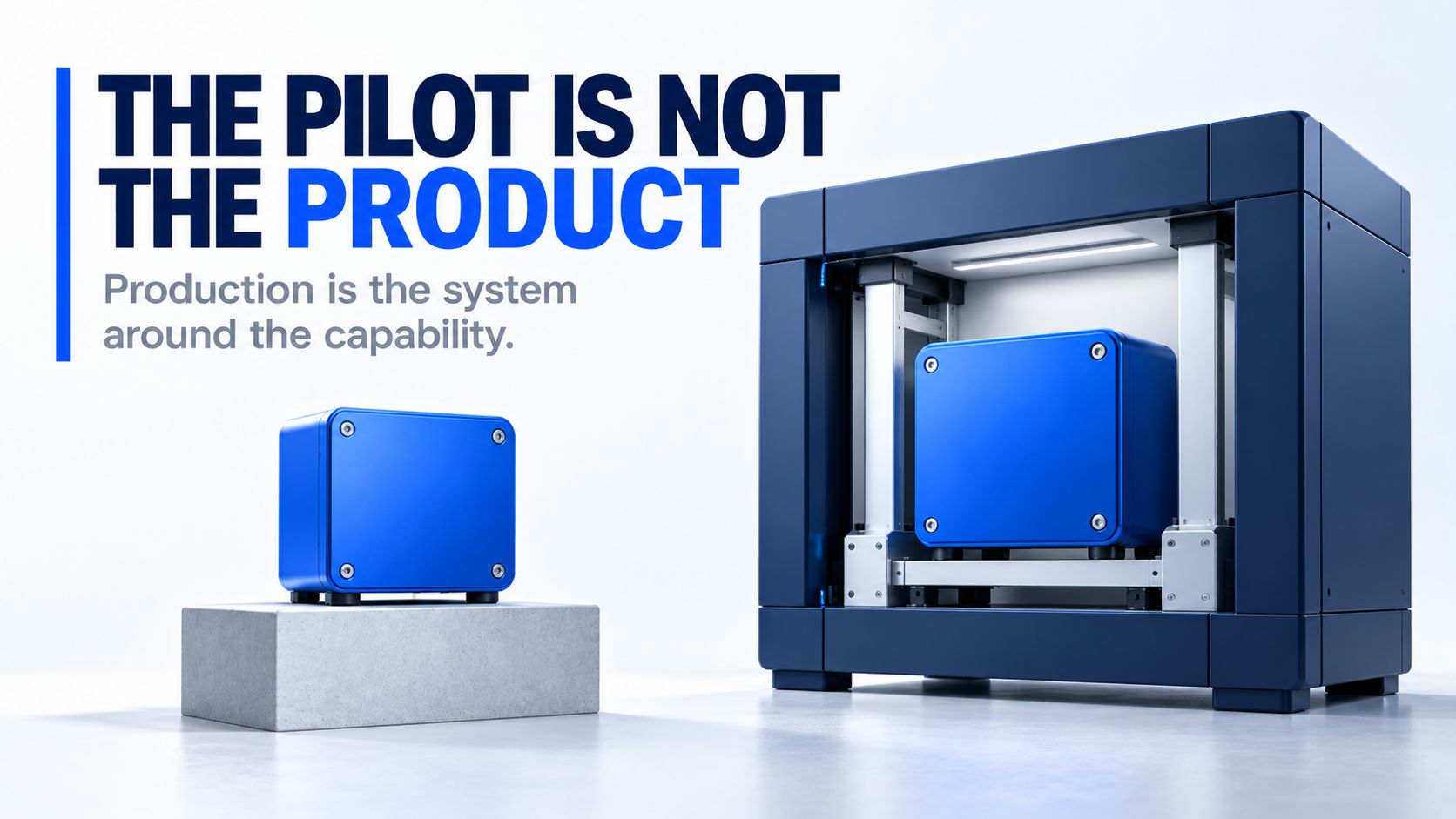
A pilot proves that a capability can work.
A product proves that the organization can run it.
Those are different tests.
An AI pilot usually begins with a narrow question. Can the model classify this document? Can an assistant draft this response? Can an agent complete these steps? Can a workflow reduce manual effort?
The team limits the data. It controls the users. It removes difficult integrations. People stand behind the pilot and correct problems manually.
That is not a flaw. It is how experiments work.
The problem starts when evidence from that controlled environment is treated as proof that the system is ready for production.
It is not.
Text version
| Pilot proves | Production must prove |
|---|---|
| The capability can work | A business owner exists |
| A useful output can be produced | Governance is designed into the system |
| The workflow can run in controlled conditions | Integration survives real systems and failures |
| The project team can keep it working | Operations can support it without the project team |
| Results look promising during the experiment | Performance is monitored in the real operating context |
| The evidence supports another decision | The capability can change, stop, or retire safely |
A pilot removes operating complexity
A useful pilot isolates the capability being tested.
It may use a sample data set instead of live records. It may serve ten users instead of ten thousand. It may rely on one subject-matter expert who knows exactly what the expected answer should look like.
The team may tolerate manual work that would never survive at scale.
Someone cleans the input.
Someone reviews every output.
Someone restarts the workflow when an integration fails.
Someone explains the system to each new user.
The pilot appears simple because people are quietly absorbing its complexity.
Production puts that complexity back into the system.
Real users enter unexpected data. Access changes. Vendors update models. Costs move. Downstream systems fail. Policies change. A generated answer reaches a customer, employee, regulator, or system of record.
The question is no longer whether the model can produce an output.
The question is whether the business can own the outcome.
Production creates an owner
Every production capability needs a person who is accountable for the business result.
Not only the model.
Not only the application.
The result.
That owner should be able to answer:
- What outcome is the system responsible for?
- Who may use it?
- What data may enter it?
- Where does the output go?
- Which decisions can it influence?
- What happens when the output is wrong?
- Who monitors quality, cost, and risk?
- Who approves a change?
- Who can stop the system?
Technical, security, legal, risk, and operational teams may support those answers. They should not be expected to invent the business decision on their own.
When ownership is unclear, the capability usually enters one of two states.
It remains a permanent pilot that never earns operational trust.
Or it enters production informally and becomes shadow infrastructure.
Neither state is a product.
Governance is part of the design
Governance is often introduced as a review near the end of delivery.
The team builds the capability. Security reviews it. Legal asks about the data. Risk asks how decisions are recorded. Operations asks who will support it.
The launch date moves.
Governance gets blamed.
The sequence is the problem.
Data classification affects architecture.
The consequence of an incorrect output affects human review.
Audit requirements affect logging.
Retention rules affect storage.
Change controls affect deployment.
Support requirements affect how the system reports failures.
These are design inputs. They are not paperwork to add after the design is complete.
NIST’s AI Risk Management Framework treats governance as a continuous function across the AI lifecycle. Its generative AI profile also calls for documented intended purposes, system inventories, testing, post-deployment monitoring, incident response, change management, override mechanisms, and decommissioning plans.
A team that waits until launch to answer those questions has not avoided governance.
It has deferred architecture.
What this does not mean
Not every experiment needs production architecture on day one. The point is to use pilot evidence to answer pilot questions, then apply a different standard before the capability becomes part of the business. Production requirements should scale with the data, authority, exposure, and consequence involved.
Integration is part of the product
A capability that sits beside the business process is still a demonstration.
A production system has to fit inside the work.
The output may need to enter a case-management platform, customer record, document repository, approval queue, or transaction system.
That creates practical questions:
- Which system remains the source of truth?
- Can the AI update a record directly?
- Does a person approve the change first?
- What happens when the destination is unavailable?
- Can the transaction be reversed?
- Is the AI output stored separately from the final approved record?
- Can someone reconstruct what happened later?
The model may be the new component.
The integration determines whether it becomes part of the business.
This is especially important for agents that can take action. OWASP identifies excessive agency, improper output handling, sensitive-information disclosure, and misinformation as distinct risks in large-language-model applications.
The more authority the system receives, the more deliberate the transaction design must become.
Support is a product feature
Pilots often depend on the people who built them.
Those people know the prompts. They understand the data. They recognize a strange response. They know which service to restart.
Production users do not have that context.
A supportable AI system needs:
- A clear service owner
- Known failure states
- Logs that help someone diagnose a problem
- Defined escalation paths
- User feedback
- Incident handling
- Model and prompt version history
- Cost monitoring
- A fallback process
- A safe way to disable the capability
The fallback may be manual.
That is acceptable.
What matters is that it is intentional.
A manual process designed as a fallback is resilience.
A person improvising because the system failed is not.
The system must keep learning
Traditional software can change because the code changes.
AI systems can also change because the model, data, prompts, retrieval sources, tools, thresholds, or user behavior changed.
That means production readiness cannot be a one-time approval.
The team needs to know what it will measure after launch.
Useful measures may include:
- Completion rate
- Exception rate
- Human override rate
- Escalation volume
- Unsupported or incorrect outputs
- Processing time
- Unit cost
- User complaints
- Performance by use case or data segment
- Changes in downstream outcomes
The correct measures depend on the system.
The principle does not.
A production capability needs evidence that it continues to work in its actual operating context.
Some pilots should stop
Not every successful pilot should become a product.
A capability may work and still be a poor investment.
The integration may cost more than the problem is worth. The process may occur too infrequently. The data may be too unreliable. The operating risk may exceed the expected value. A simpler automation may solve most of the problem.
Stopping can be the right result.
A pilot should reduce uncertainty.
It should not create a political obligation to proceed.
Before the pilot begins, the team should define what evidence would support three decisions:
- Continue to production.
- Run another experiment.
- Stop.
A pilot without stopping criteria is not an experiment.
It is a demonstration waiting for sponsorship.
The production test
Before calling an AI capability production-ready, answer these questions in plain language:
- What business outcome does the system support?
- Who owns that outcome?
- What data enters, leaves, and remains?
- Where does human judgment enter the process?
- How does the output reach the system of record?
- What is monitored after launch?
- How are changes approved, tested, and reversed?
- What happens when the system is unavailable or wrong?
- Who can stop it?
- What evidence would justify retiring it?
The answers do not need to be elaborate.
They need to be real.
Conclusion
A demo proves possibility.
Production proves ownership.
The work is not complete when the model generates the right answer in a controlled room. It is complete when the organization can operate, govern, support, change, and eventually retire the capability without depending on the original project team.
The pilot is not the product.
The operating system around it is what makes it one.
Sources and notes
- NIST AI Risk Management Framework 1.0, including lifecycle governance, continuous risk management, organizational roles, system inventories, and human-AI interaction.
- NIST Generative AI Profile, including intended-use documentation, third-party controls, testing, monitoring, incident response, override, change management, and decommissioning.
- OWASP Top 10 for LLM Applications 2025.